
The JUST STREETS Urban DNA© Method: Turning Data into Action
Everything Starts with Data
Every day, vast amounts of data are collected, measured, and communicated.
We track traffic speeds, air pollution, energy use, carbon emissions, noise levels, health indicators, and countless other metrics. Data has become the foundation of how we understand our cities and societies.
It helps us identify problems, detect patterns, and make complex systems visible. But despite all this data, meaningful change often remains frustratingly slow. Why? Because…
Data alone rarely changes behaviour.
Even the strongest evidence does not automatically lead to better decisions or meaningful action. Reports are read, dashboards are shared, presentations are delivered — yet behaviour often remains unchanged.
For data to truly matter, it needs to be translated.
Raw numbers need to be decoded, contextualised, and communicated in ways that make them relevant to the people who need to act.
And that translation must be audience-specific and action-oriented.

From Information to Relevance
Not everyone responds to the same data in the same way.
The exact same dataset can tell very different stories depending on who receives it. A traffic planner may respond to safety metrics and modal split. A parent may care about whether their child can safely walk to school. A politician may focus on public acceptance, costs, and visible impact.
The data itself does not change., but the story and its potential to trigger action does. For this reason communication cannot stop at presenting facts.
The real challenge lies in turning information into relevance.

This Is Where the Urban DNA© Method Comes In
Developed by Urban Future within the JUST STREETS project, the Urban DNA© Method helps transform raw data into meaningful narratives that motivate specific audiences to act.
Its logic is simple but powerful: Data → Narrative → Action
The method starts with a fundamental shift in thinking. Instead of asking: “What does the data tell us?” we ask: “Who needs to act — and what will move them to act?”
This shift changes everything, because once communication becomes audience-centred rather than data-centred, the chances of creating real impact increase dramatically.
The Core Skill: Perspective-Taking
At the heart of the Urban DNA© Method lies one essential skill: perspective-taking.
To communicate effectively, you need to step into the mindset of your target audience and understand how they see the world.
What matters to them?
What motivates them?
What do they fear losing?
What may hold them back?
Which language, framing or evidence will resonate?
This requires not just analytical thinking, but empathy.
The better we understand our audience, the better we can interpret and translate data in ways that are not only understood, but meaningful enough to trigger the behaviour or decision we seek.
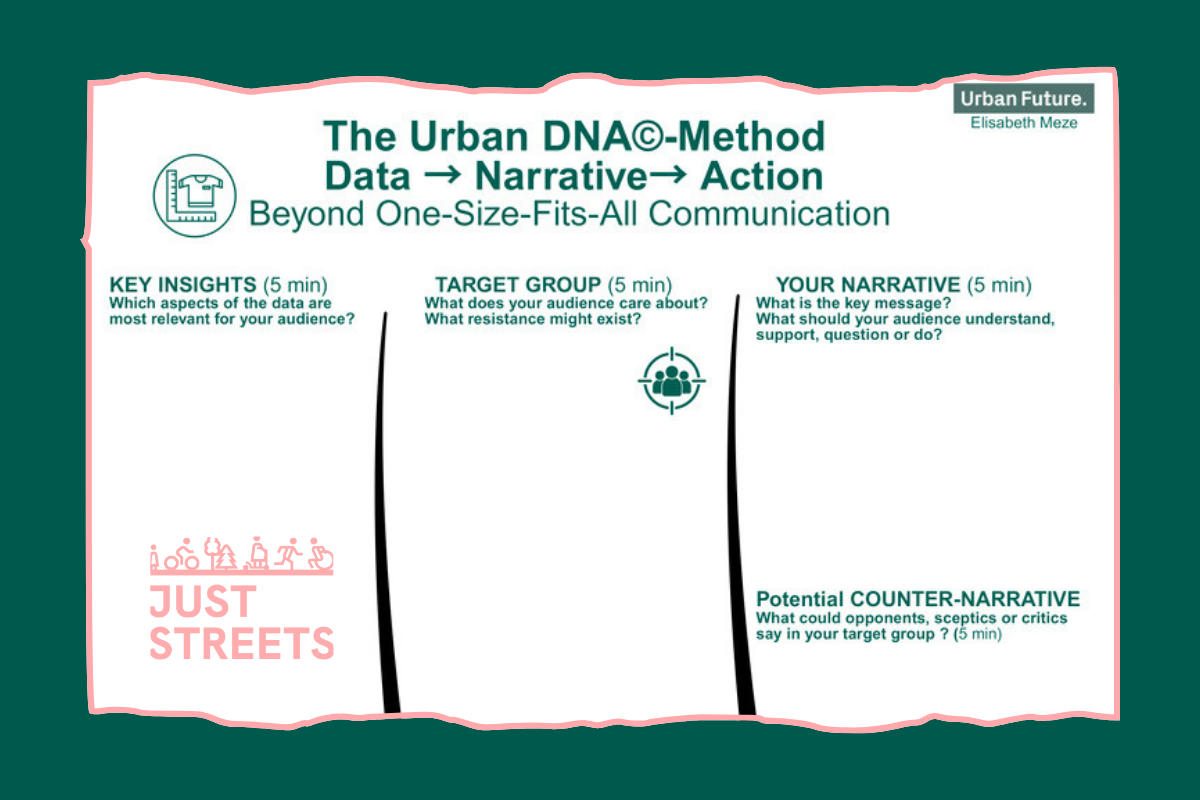
The Data → Narrative → Action framework at the core of the JUST STREETS Urban DNA© Method
From Narrative to Action
A strong narrative does more than explain data. It creates urgency, emotional connection and clarity around what needs to happen next. However, applying the Urban DNA© Method also means anticipating resistance.
Every message competes with existing beliefs, habits, assumptions and excuses.
People may think change is too expensive, politically impossible, inconvenient, or simply not urgent enough. That is why effective communication must also account for likely counter-narratives and barriers to action.
The strongest narratives do not only communicate benefits, but address resistance and reduce uncertainty. They help people move from hesitation to action.
The Urban DNA Worksheet
To make the Urban DNA© Method practical, we developed the Urban DNA© Worksheet, a structured tool that helps individuals and teams apply the method to their own challenge.
The worksheet guides users step by step: from defining the challenge and identifying the target audience, to selecting relevant data, crafting narratives, testing counter-narratives, and defining concrete actions.
The goal is not to communicate more information, but to trigger better decisions — and ultimately get things done.
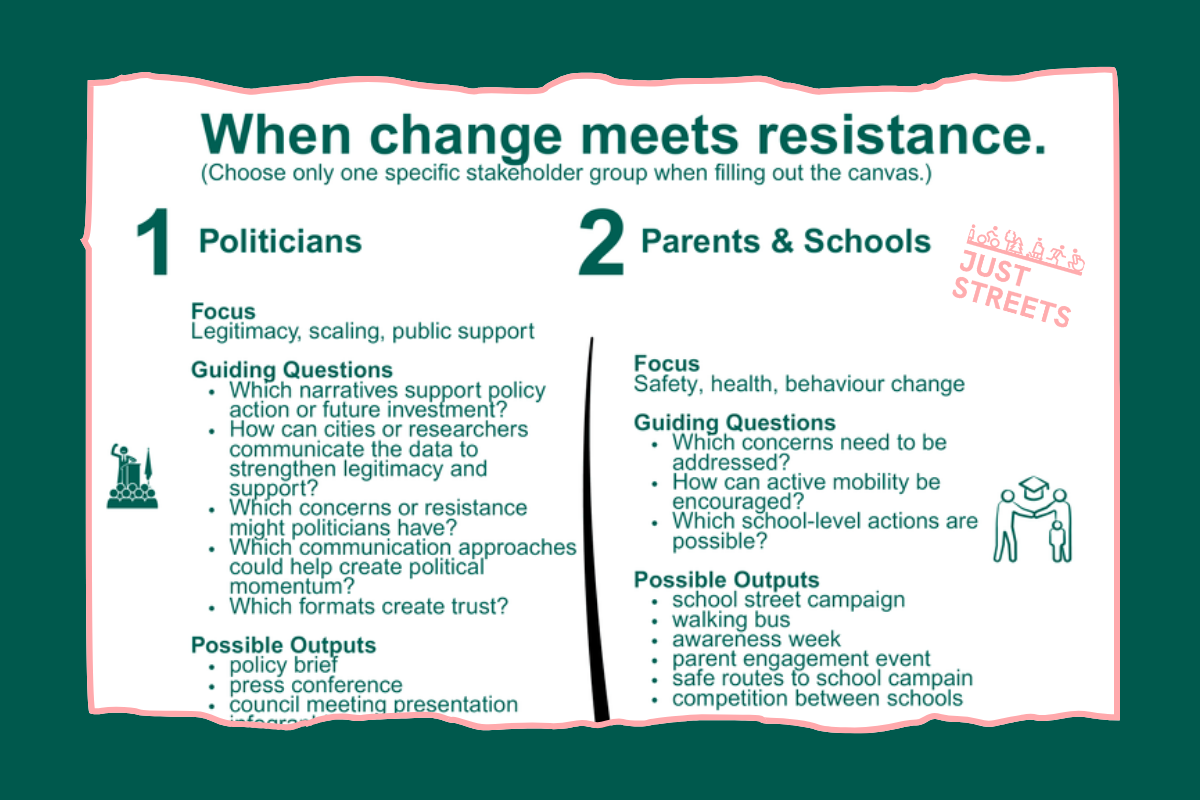
The "When Change Meets Resistance" framework explores why street transformation can be challenging and how to move projects forward.
Beyond Mobility
Although the Urban DNA© Method was developed in the context of mobility and street transformation, it can be applied far beyond that. Wherever data needs to move people — whether in climate action, energy transition, health, housing, public participationn or organisational transformation — the method can help.
Because in the end, one this is true: people don't act on data, they act on relevance.